

How To Choose The Right Edc Tactical Flashlights 2026
By Cole Briggs
In my years on the street, I’ve seen more people fumble with a dead phone flashlight in a dark alley than admit they need a dedicated light. A tactical flashlight isn’t just about seeing; it’s about controlling your environment and signaling intent. When you draw a knife or a gun, your light source must be instantly accessible, reliable under stress, and bright enough to disorient an aggressor while illuminating a threat. Choosing the wrong unit means carrying dead weight that fails when the sun goes down.
Quick Answer
For daily carry, prioritize a sub-1000-lumen flashlight with a simple single-button interface and a high-quality Cree or Luminus LED. You need a light that fits your pocket without printing, runs on standard CR123A batteries for longevity, and features a durable aluminum alloy body. Avoid gimmicky "turbo modes" that cook the battery; focus on runtime, beam distance, and reliability over raw peak brightness.
Table of Contents
Our Top Picks
Affiliate disclosure: if you buy through these links, we may earn a commission at no extra cost to you.
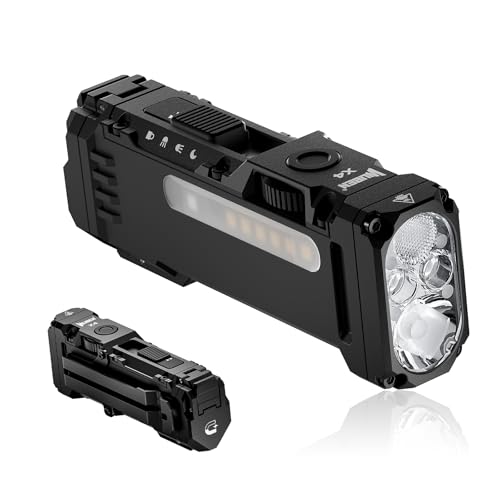


The Reality of Pocket Carry
Most EDC gear fails because it doesn't fit the user's life, not because the product is bad. A tactical flashlight that weighs 8 ounces will ride your belt like a brick or sit in your bag where you can't reach it in seconds. For daily carry, we are looking for a balance of utility and discretion. You want something that sits comfortably in a jeans pocket without digging into your thigh when you sit down.
Size is the primary filter here. The "keychain" form factor is great for quick access but lacks the throw distance needed for tactical situations or searching large areas. Conversely, a full-sized patrol light is overkill for checking a breaker box at home. Aim for the mid-size range: roughly 4 to 5 inches in length and under 2 ounces. This allows for a battery pack capable of sustained output while remaining pocket-friendly.
Lumens vs. Candela: Seeing the Difference
Marketing departments love to lie with numbers. They will advertise 3000 lumens on a tiny keychain light that burns out in four minutes. You need to understand the difference between lumens and candela. Lumens measure the total amount of light emitted in all directions. Candela measures the intensity of the beam at its center.
For tactical use, candela is king. You want a focused beam (spotlight) that can reach down a long hallway or illuminate a face across a parking lot. A wide flood beam (like a camping lantern) looks impressive in a box but is useless for identifying threats at distance. Look for a "throw" rating that matches your environment. If you are carrying this for home defense, a tight spot with 200+ candela is sufficient. If you patrol large perimeters, look for higher throw ratios.
Battery Architecture Matters
Nothing kills credibility faster than a flashlight that requires proprietary batteries. When the situation goes south, you don't want to be hunting down a specific brand of lithium cell at a gas station. The gold standard for EDC tactical lights is the CR123A battery. They are widely available, have a long shelf life (5-10 years), and perform consistently in cold weather.
Avoid rechargeable-only units unless you are disciplined about charging them nightly. Lithium-ion cells degrade over time and can fail catastrophically if damaged. CR123A batteries are disposable for a reason: they are reliable until the moment they aren't, then they just stop working. This predictability is vital in high-stress scenarios. If you prefer rechargeable, ensure the unit uses standard 18650 or 21700 cells that fit in generic chargers.
Switch Mechanics and UI
In a dark, high-adrenaline situation, fine motor skills disappear. You need a user interface (UI) that works with muscle memory. Avoid complex menus that require double-clicking or holding buttons to access modes. A simple tail-switch or side-switch is superior for tactical applications.
The "Turbo" mode on many modern lights dumps maximum power instantly, heating the body and draining the battery in minutes. This is a gimmick. You want a light with a strong "Low" or "Medium" mode that can run for hours. Use the high mode only when necessary to conserve power and prevent overheating. A momentary-on function (light turns on only while button is pressed) is essential for tactical use, allowing you to check corners without revealing your position.
Build Quality and Materials
Your gear will take a beating. It will drop on concrete, get rained on, and possibly be used as an impact tool. The body must be made of hard-anodized aluminum alloy (6061 or 7075). This provides corrosion resistance and extreme durability. Avoid plastic bodies; they crack under stress and cannot be used for self-defense.
Look at the lens. Sapphire is nice, but hardened glass is sufficient and cheaper to replace if shattered. The bezel should have teeth (ratcheting) to serve as a striking surface. However, do not buy a light solely because it looks like a weapon. A smooth bezel is less likely to snag on clothing during a draw. Balance your need for impact resistance with the practicality of daily carry.
Frequently Asked Questions
Is a strobe mode necessary?
Yes. A bright, disorienting strobe can buy you critical seconds to escape or reposition during an attack. Ensure the strobe is accessible without navigating complex menus.
Should I get a rechargeable flashlight?
Only if you are disciplined. Rechargeable batteries lose capacity over time and require specific chargers. For pure reliability, disposable CR123A batteries are the professional choice.
What is the best color for the light beam?
White light (5000K-6000K) is standard for visibility. Blue or red beams are specialized tools for preserving night vision or detecting blood, but they are not primary carry options.
Can I use a flashlight for self-defense?
A bright light can disorient an attacker, and the hard aluminum body can be used as an impact tool. However, do not rely on it as your primary defense. It is a force multiplier, not a weapon.
How many lumens do I actually need?
For EDC, 500-1000 lumens is the sweet spot. Anything over 2000 lumens in a pocket-sized unit will likely overheat and drain quickly, offering diminishing returns.
Selecting the right tactical flashlight is about balancing power with practicality. Do not get seduced by marketing numbers or flashy features. Focus on reliability, battery availability, and ease of use. Your gear should work for you, not against you. Test your light in the dark before you carry it. Make sure you can operate it with gloves on and in total darkness. If you cannot find the switch by feel, put it back.
The Verdict: Stick to a simple, hard-anodized aluminum flashlight running on CR123A batteries with a momentary-on tail switch. It is the standard for a reason. Not for you if: You are looking for a camping lantern or a specialized blue-light blood detector. This guide is for serious daily carry utility.


